Blogs
Training advice, inspirations, and motivations all found here.
#26: Have a Horse That Doesn't Want to Go Forward?
Oftentimes, horses who seem lazy or unmotivated are actually struggling with a brain stuck in a state of self-preservation. These horses are frequently labeled as "dull" or "resistant," but from a neurological perspective, what looks like a lack of motivation is often a high level of internal stress, fear, or lack of clarity.
When a horse feels unsafe or overwhelmed, the brain can trigger a freeze response. This isn't a choice he is making to be difficult; he is not being stubborn or lazy. It is simply his nervous system telling him that staying still is the only way to remain safe.
The science is clear: all behavior serves a purpose. Horses are either seeking something they want or avoiding something they don’t. Because they lack the highly developed pre-frontal cortex found in humans, they aren't capable of "plotting" or "planning" to be difficult.
Reasons for a lack of forward movement vary—from physical pain (which should always be investigated first) and rider imbalance to a lack of salient cues or a general fear of the environment. To help these horses, we must look at three distinct psychological states:
- Avoidance: An active strategy where the horse stops to prevent a perceived negative outcome.
- Dissociation: An internal coping mechanism where the horse is physically present but mentally "checked out."
- Learned Helplessness: A profound state where the horse has learned that no matter what he does, he cannot escape pressure, leading him to stop trying altogether.
In all three cases, the horse isn't being stubborn; he lacks the emotional safety to engage with the question.
To move past these states, we must shift the horse's experience from resignation to empowerment. This is where positive reinforcement is a game-changer. Instead of using pressure to force movement—which often deepens the shutdown—we use a clear bridge signal and high-value reinforcement to reward the smallest effort.
This clarity gives the horse a reason to want to participate. We are teaching him that his environment is predictable and his actions have value, allowing him to move out of the reactive brain and into the thinking brain.
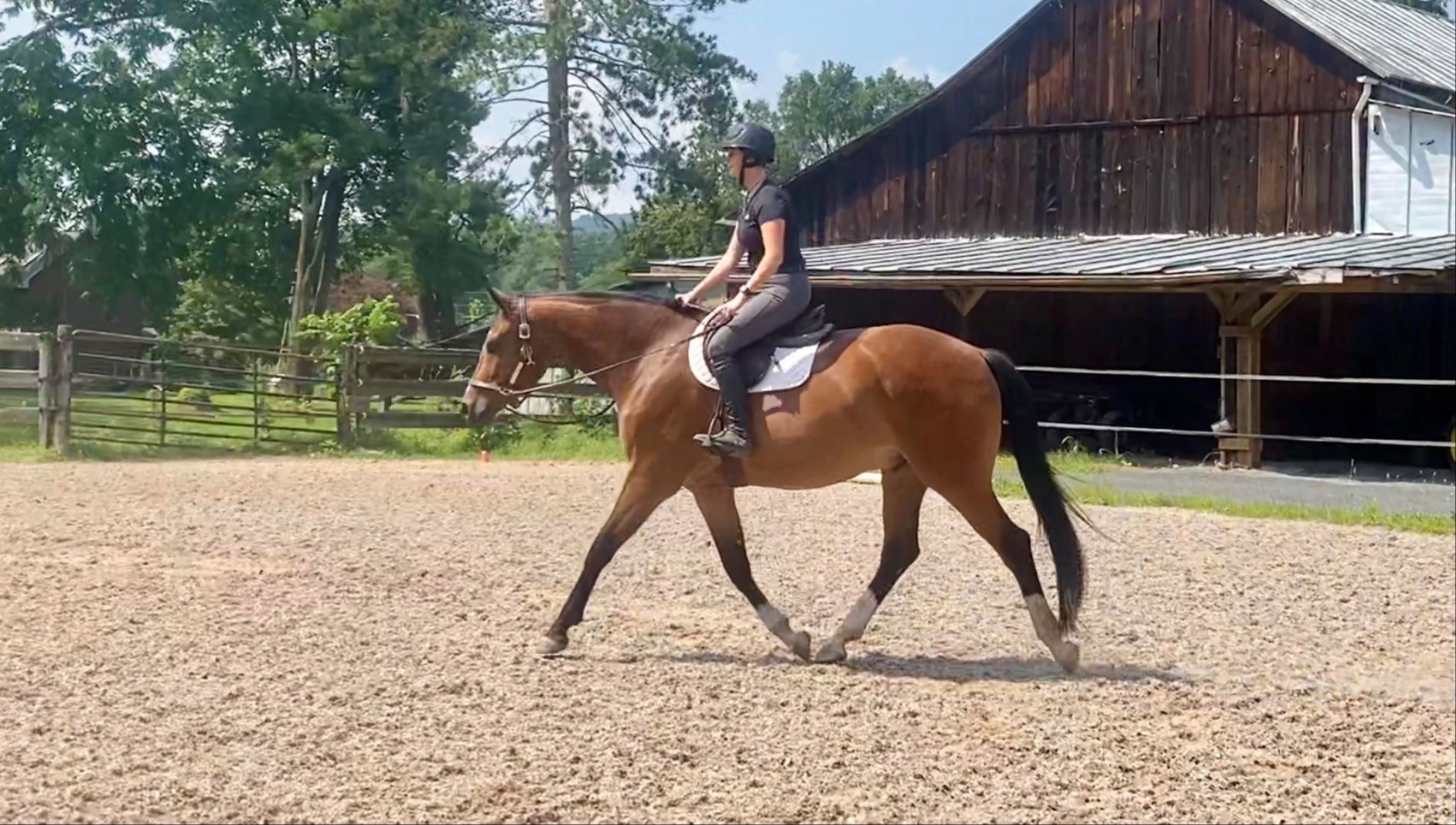
The target is one of the most powerful tools we have to bridge this gap. For a horse struggling with dissociation or learned helplessness, a target provides a clear, low-pressure focal point that demands very little physical exertion but offers a big payoff.
Touching a target is a simple task that the horse can be successful at almost immediately. When he touches the target and hears the bridge signal followed by reinforcement, he begins to realize that he has agency.
This realization is the antidote to learned helplessness. It is what begins to help the brain form new neural pathways for problem-solving. It also creates that brilliant "heart" and "try" in horses—traits we previously thought couldn't be taught. They can.
We can then start to move the target to new locations and play games, such as sending the horse across the arena or over a jump. These simple games help our horses feel successful and listened to. The desire to reach the target, rather than the need to escape a leg or a whip, is the foundation of true internal motivation. The impetus for the behavior changes the brain’s motivation entirely.
Overcoming a lack of forward movement starts by breaking everything down into achievable pieces. We begin on the ground where the horse feels most secure. We introduce the target and reinforce for simply acknowledging it, then for touching it, and eventually for moving toward a target placed on a cone.
Soon, we are clicking for moving forward to the target and eventually fading the target out (though we bring it back occasionally to keep motivation high). This systematic approach rewires those neural pathways to feel good about forward movement.
Finally, we gradually transition this concept to under-saddle work. By keeping the sessions short and the rate of reinforcement high, we ensure the horse stays in a positive emotional state. We aren't just training a behavior; we are rewriting the horse's internal narrative and showing him that his voice and his efforts actually matter.